

Awareness of climate-positive publishing has grown significantly in recent years. So too has the number of readers and authors actively choosing to support ethical and sustainable companies. In response to growing concern over the book industry’s emissions, publishers must continue to evolve their practices to remain competitive.
However, alongside the ever-growing pressure for publishers to adopt more environmentally friendly practices, greenwashing is sadly becoming more common. This deceptive marketing strategy gives products and services the illusion of being more sustainable than they truly are, making it increasingly important for readers and authors to look beyond environmental claims at the evidence behind them.
While most publishers are genuinely striving to reduce their carbon emissions – through switching to certified paper, cutting waste, updating supply chain routes or investing in print-on-demand – some embellish the truth to appear more environmentally responsible. At Easypress, we believe that greater transparency around sustainability claims is crucial as publishers look for practical ways to reduce their environmental impact.
So, how can you tell the difference between legitimate climate pledges and greenwashing?
A publisher that broadly claims they print using sustainable paper may be misleading consumers. In 2026, publishers and printers can use verifiable data to prove their paper is responsibly sourced, and this information should be clearly publicised on their websites. Without legitimate certifications, eco-friendly marketing language can create the impression of climate-conscious publishing without the evidence to support it. More often than not, if a publisher cannot or will not disclose the relevant information, it is a sign of greenwashing.
In the digital era, certifications can be faked with relative ease, and FSC logos displayed on a publisher’s website or a book’s copyright page are no exception. Spotting a fake FSC logo requires looking past the graphic itself, as counterfeiters can easily reproduce the recognisable checkmark-and-tree design. To determine whether an FSC logo is genuine, you should verify the unique licence number shown within the label. The official licence number format for certificate holders, including printers and publishers, is FSC-C followed by six digits. If necessary, you can report suspected misuse of the FSC trademarks via the FSC website.
Publishers that promote a single positive environmental attribute of their operation but ignore all other sustainability measures tend not to be as climate conscious as they claim. For example, a publisher whose only climate-conscious claim is that they print using soy- and vegetable-based inks, but which ignores the larger issues contributing to its carbon footprint (such as paper sourcing, printing energy, shipping and overproduction), may be trying to distract from broader sustainability issues within its business operations.
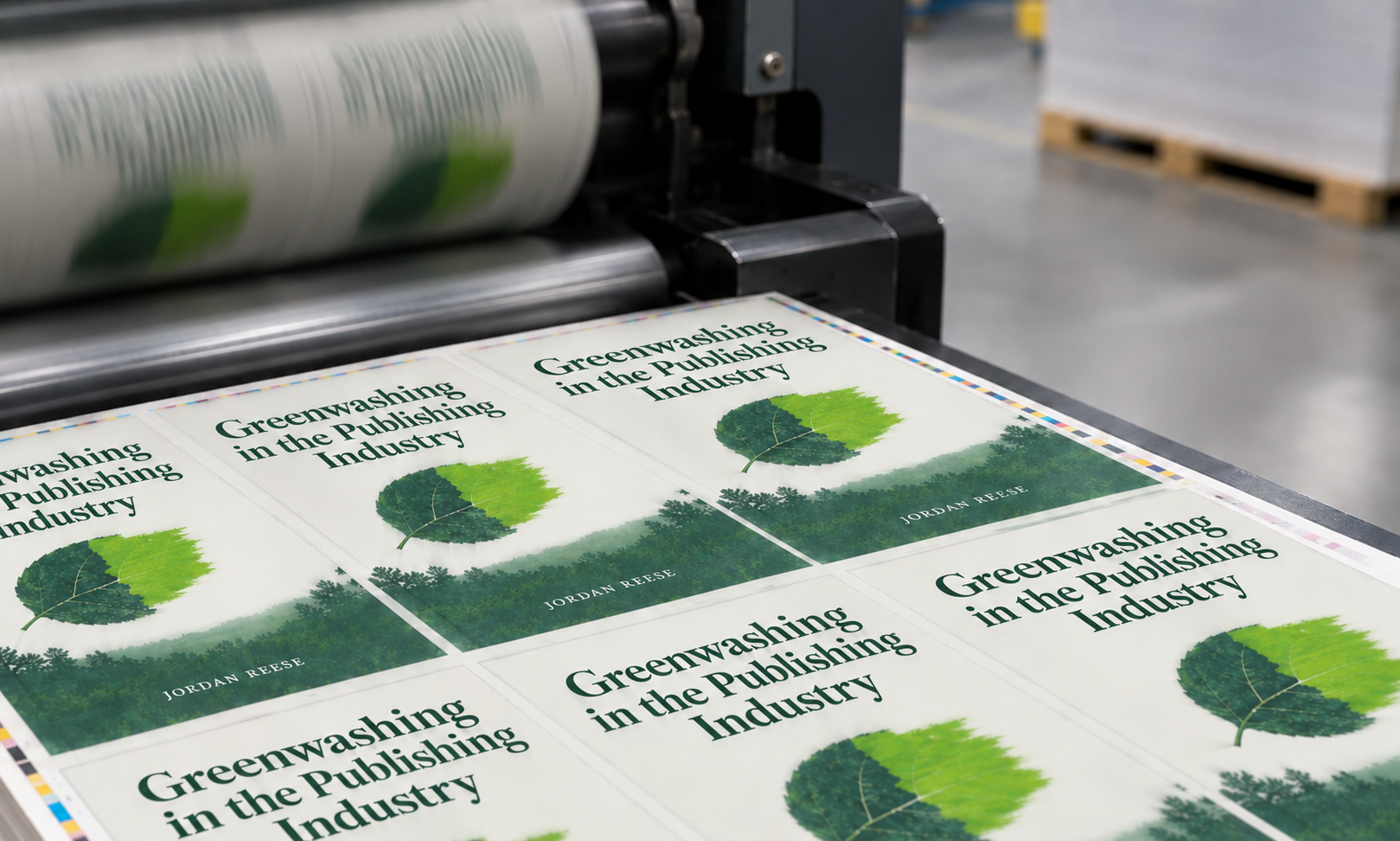
Publishers that use broad environmental language such as ‘eco-friendly’, ‘naturally sourced’ and ‘climate conscious’ without any accompanying statistics, certifications or action plans should be treated with caution. If there’s no data to support their claims, such as exact recycled percentages or emissions reports, it may just be a marketing strategy. These vague terms can often accompany company branding that uses earthy colour palettes, leaf and tree motifs, and handwritten or rustic fonts to promote a ‘natural’ aesthetic, making unfounded sustainability claims more believable.
With a staggering number of books sent to landfill globally every year, most reputable publishers are striving to reduce overproduction. If a publisher has no clear policy on reducing overproduction (such as adopting print-on-demand services, improving stock forecasting or producing smaller print runs), they’re likely contributing to significant waste through high volumes of surplus stock held in warehouses.
Membership of initiatives such as The Book Chain Project is a strong indicator of legitimate climate commitments by publishers. This collaborative, industry-led initiative helps publishers and printers take greater responsibility for their environmental impact by enabling them to track and report the forest sources of their paper, mill environmental performance, water risks, and the chemicals used in their inks and glues.
Publishers who support local printing are typically more climate-aware than those that rely on printing overseas. Often listed on a book’s copyright page or a publisher’s website, ‘printed in [your country or region]’ usually means lower transport emissions by reducing the need for long-haul air freight or ocean shipping from factories. Local and regional printing supports shorter supply chains and greener logistics.
One of the most trusted signs of responsible paper sourcing is the FSC logo, which may appear on a printed book’s copyright page or on a publisher’s or printer's website. There are three different types:
If a publisher is making bold sustainability claims, are they supported by well-known industry action plans? One example is being listed as part of the Publishing Declares initiative by the Publishers Association. Signatories of industry-wide initiatives commit to a five-point plan to reduce their environmental impact, demonstrating positive intention and an awareness of how to implement legitimate sustainability strategies. Similarly, pledges to the SDG Publishers Compact ensure that signatories aspire to develop sustainable practices and act as champions of the Sustainable Development Goals during the Decade of Action (2020–2030).
With the increased availability of print on demand, climate-conscious publishers are commonly offering these services as standard. Printing books to order drastically reduces the risk of overproduction and potential pulping waste. These services can also provide more localised printing, reducing transport emissions from shipping printed books from overseas warehouses. Print on demand is one of the most effective ways to minimise industry waste.
We believe that meaningful sustainability should be based on practical action rather than vague environmental claims. As publishing workflows continue to evolve, services such as print on demand and digital production can help publishers make more considered decisions around production and distribution, but transparency matters just as much. Genuine commitments should be supported by evidence, recognised certifications and measurable actions. After all, painting something green is rather easier than making it so.
At Easypress, we help publishers streamline production through flexible digital tools and services. To find out more about how we support modern publishing workflows, why not get in touch?
Try our print and digital publishing platform for free today.
Contact us and we will provide the best solution to suit your digital publishing needs.
Get all the latest blogs straight to your inbox!


