

By the third or fourth draft, many writers find themselves thinking less about finishing their novel and more about what comes next.
The publishing world can feel surprisingly difficult to navigate at this stage. Self-publishing, traditional publishing, hybrid options: authors are faced not only with more options than ever before, but also with a confusing amount of industry jargon and conflicting advice.
This blog aims to cut through the confusion and make the different publishing routes easier to understand.
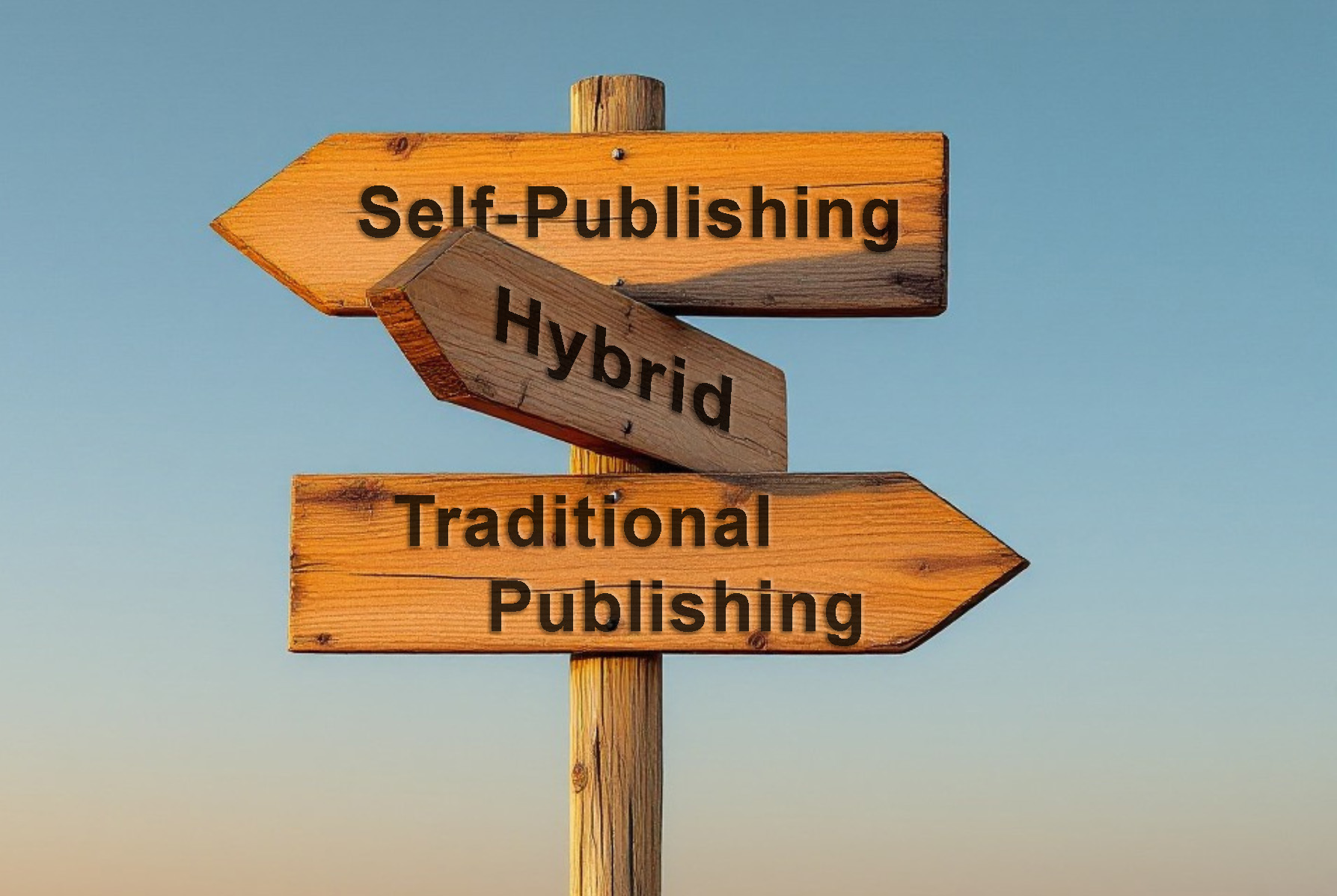
There are three options to choose from:
None are inherently better; they just prioritise different things.
A traditional deal can bring that longed for validation, whilst self-publishing offers full creative autonomy. Hybrid publishing, on the other hand, promises speed.
The right choice depends on what the writer wants for their manuscript and their writing life more generally.
This is the path most writers associate with bringing a book to life: securing an agent, signing with a recognised publisher, and eventually seeing their book on a shelf in Waterstones.
That could mean one of the larger houses such as Penguin Random House, Hachette, Harper Collins, Simon & Schuster or Macmillan, or an independent press like Canongate, Daunt Books or Granta.
In most cases, especially with larger publishers, a literary agent is needed. Some smaller presses accept direct submissions, but competition is still intense.
The author should never pay to be traditionally published. The publisher covers editing, design, printing and distribution. That said, writers are increasingly expected to be visible and engaged when it comes to promotion.
One of the biggest surprises for new authors is the timeline. It is not unusual for eighteen months to pass between signing a contract and publication. That pace can feel frustratingly slow.
Those fortunate enough to secure a deal should consider having the contract reviewed by the Society of Authors to secure expert guidance before committing to legally binding terms.
Self-publishing places the author in the role of publisher. Rather than securing an agent and signing with an established house, the author commissions and coordinates each stage of production independently.
This involves assembling a professional team – typically freelance structural editors, copyeditors, proofreaders, designers and typesetters – and overseeing the project from manuscript to finished book.
Professionals may be found through organisations such as the Chartered Institute of Editing and Proofreading (CIEP), the Editorial Freelancers Association (EFA), Reedsy, or through trusted recommendations within publishing networks.
Most UK authors publish through:
Self-publishing has evolved significantly over the past decade. When professionally produced, a self-published book can be indistinguishable in quality from one released by a traditional house.
Some writers are drawn to self-publishing because it offers an appealing alternative after exploring the traditional route. Others choose this route because they have a clear creative vision and prefer not to compromise.
Authors pursuing this route benefit from seeking professional advice early, budgeting realistically and approaching the process with the same rigour expected in any established publishing house.
A realistic timeline is typically six to nine months, depending on scope and the availability of freelance professionals.
Professional support is available. Organisations such as the Alliance of Independent Authors (ALLi), the Society ofAuthors, and the EFA offer resources, directories and guidance to help independent authors navigate contracts, standards and best practice.
Hybrid publishing sits somewhere between traditional and self-publishing.
Under this model, the author pays a company to manage editing, design, production and sometimes distribution. The financial investment comes from the writer, but the responsibility for sourcing and coordinating freelancers rests with the company.
In theory, hybrid publishing offers the structure of traditional publishing alongside the flexibility of self-publishing. In practice, quality and transparency vary.
The appeal often lies in having a single point of contact and a managed process. However, the level of editorial input and the reach of distribution can differ significantly from one provider to another.
While certain hybrid publishers operate transparently and deliver genuinely professional results, others resemble vanity presses, charging substantial fees without offering meaningful editorial development or effective distribution.
Before signing, careful scrutiny is essential. Prospective authors should look closely at what is included: how many rounds of editing are provided, who is responsible for cover design, and what distribution genuinely entails.
It is also wise to examine the company’s track record. Have they worked with recognised publishers or established independent authors? Can they provide examples of recent titles? What experience and qualifications do their editorial and design teams hold? Independent feedback from previous clients can offer valuable insight into the quality of service and professionalism delivered.
Organisations such as the Alliance of Independent Authors and the Society of Authors offer guidance and contract advice to help authors assess hybrid publishing agreements with clarity and confidence.
There is no single correct route – only the one that aligns with an author’s goals and expectations.
Finishing a manuscript takes determination; choosing how to publish it deserves equal care.
Easypress is in a unique position: we work with major traditional global publishers such as Penguin Random House and Open Road Media, as well as a wide range of independent authors and small presses.
We provide bespoke publishing services, such as design and typesetting, copyediting and proofreading, as well as publishing software and guidance. If you’d like advice about what publishing route would best suit you, please contact us via our website or through sales@easypress.com
Alternatively, you can schedule an online meeting for a time to suit you via our Calendly page.
Try our print and digital publishing platform for free today.
Contact us and we will provide the best solution to suit your digital publishing needs.
Get all the latest blogs straight to your inbox!


